
Accelerationism, Extreme Nihilism, and Tyler Robinson

If you’ve been lurking online, scrolling through the darker corners of social media, or just trying to make sense of the chaos around you, you’ve probably bumped into the word accelerationism. Here’s the short version: it’s the idea that you can push systems—capitalism, technology, social norms—to their breaking point, either to bring radical change or just watch everything collapse. And here’s the kicker: it doesn’t have to be left or right. Some people do it for ideology, some for the chaos, some literally for the LOLs.
Pair that with extreme nihilism, and you’ve got the philosophical cocktail of the internet age. Nihilists reject rules, morals, and societal expectations. They’re not here to fix things—they’re here to see the structures fall apart and, in some cases, revel in it. Together, accelerationism and nihilism are less about politics and more about pushing boundaries, testing limits, and questioning everything you thought was permanent.
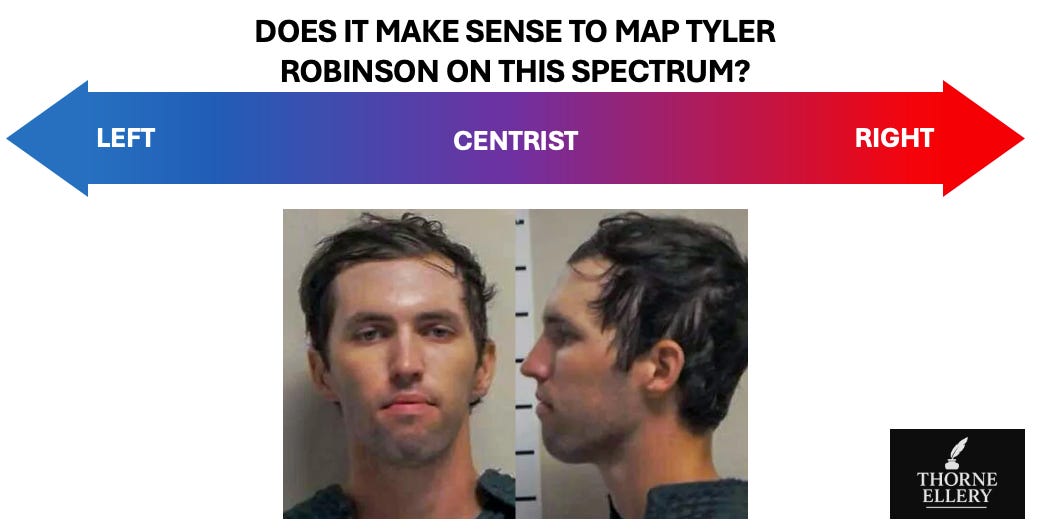
Enter Tyler Robinson. The initial reaction was to try to label him as left or right, but from what we know about him so far, he might be nowhere on that spectrum. His motives we potentially to provoke, push norms, challenge morality, and expose dividesWhether he calls himself an accelerationist or nihilist isn’t the point. What matters is that he embodies the chaos these theories describe: pushing society to see what happens when limits are tested. Robinson may not be trying to solve anything but murdering Charlie Kirk; his sole purpose may just be shaking the body politic up.
How does transgender play into this? Identity itself can be accelerationist and nihilistic. Take transgender identity. Transitioning—through hormones, surgery, or simply living authentically—challenges society’s expectations of the body and gender. For left-accelerationists, this can be a form of Promethean boundary-breaking: reshaping what it means to be human, defying the “given” rules. For nihilists, it’s a radical rejection of inherited norms, a refusal to be boxed into a system that says, “This is who you are.” Both perspectives see identity as a playground for experimentation, disruption, and transformation.
Why does this matter? Because accelerationism and nihilistic extremism aren’t just academic theories or internet edgy content—they’re giving a generation a new lens for interpreting and contributing to chaos in the real world.
The takeaway: these ideas are everywhere, and now’s the time to pay attention to understand the forces shaping the world and the provocateurs testing its limits. Because whether you like it or not, the future is being accelerated—and sometimes, it’s happening just for the thrill of seeing what comes next
.